P0420 Does Not Mean Replace the Converter
P0420 or P0430? Don’t Replace the Converter Until It’s Tested
- P0420 = Catalyst System Efficiency Below Threshold, Bank 1
- P0430 = Catalyst System Efficiency Below Threshold, Bank 2
- The PCM is detecting that catalyst performance has fallen below its calibrated threshold.
- The PCM generally determines this by comparing exhaust oxygen behavior before and after the catalyst.
- The code identifies an efficiency problem, not necessarily the component that caused it.
EPA OBD requirements specifically include monitoring of catalyst efficiency, oxygen sensors, misfires and fuel metering/trim, which is why these systems have to be considered together during diagnosis. Before we recommend a catalytic converter, we determine whether the converter failed, whether another problem is making the converter appear inefficient, or whether an engine problem damaged the converter in the first place.
“Route 40 Auto won’t sell you a catalytic converter your vehicle doesn’t need.”
Why Did My Catalytic Converter Fail?
Replacing a converter without fixing what destroyed it can result in another failed converter.
Why Catalytic Converters Fail:
- Engine misfires → raw fuel overheats the catalyst
- Rich fuel mixture → excessive fuel damages the converter
- Oil consumption → contaminates the catalyst
- Coolant consumption → contaminates the catalyst
- Ignition problems → incomplete combustion
- Fuel-system problems → improper air/fuel ratio
- Physical damage/rust → damages the converter or exhaust
- High mileage/age → eventual catalyst deterioration
Finding the cause of converter failure is just as important as replacing the converter.
Check Engine Light With P0420 or P0430?
P0420 — Catalyst System Efficiency Below Threshold Bank 1
P0430 — Catalyst System Efficiency Below Threshold Bank 2
These codes indicate that the ECM has detected catalyst efficiency below the expected threshold. They do not, by themselves, identify why efficiency is low or prove that simply replacing the converter will correct the underlying problem.
Have a P0420 or P0430 code? Schedule a free catalytic converter test. Walk-ins are welcome—no appointment necessary.
How We Diagnose a Catalytic Converter
1. Scan the vehicle for trouble codes
We scan for P0420/P0430 along with related misfire, fuel-trim, oxygen-sensor, MAF, injector, ignition and engine-temperature codes that may help explain why catalyst efficiency is low.
2. Inspect the exhaust system
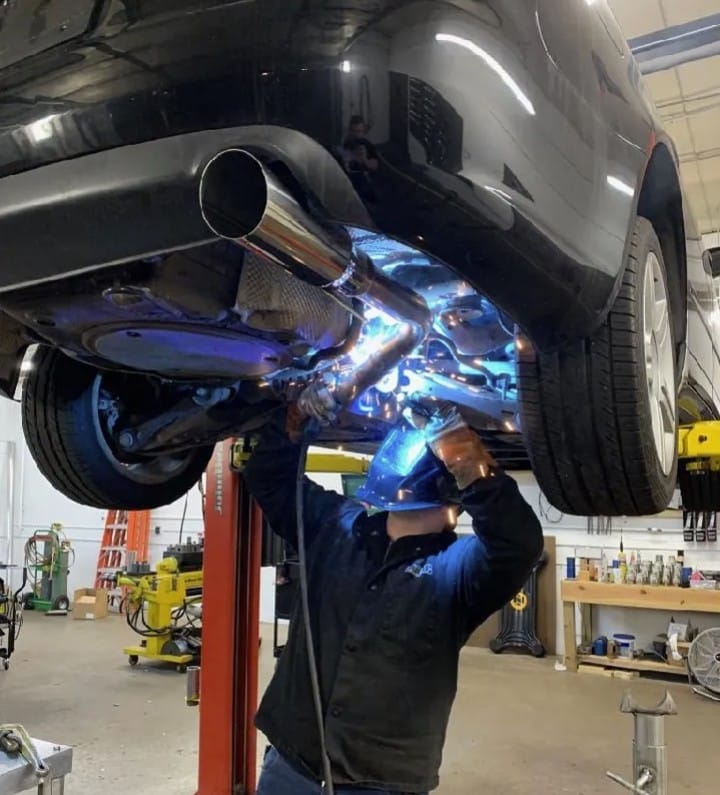
Listen for leaks at the exhaust manifold, pipe flanges, flex pipes, welds, seams, sensor bungs, pipe joints and physical converter damage. Because Route 40 Auto specializes in both exhaust repair and engine diagnostics, we can test the emissions system and repair exhaust leaks in the same shop.
3. Analyze freeze frame and operating conditions
Freeze-frame data records the conditions present when the fault occurred, including engine RPM, load, coolant temperature, vehicle speed, short-term fuel trim and long-term fuel trim. Reviewing this information helps us determine whether another engine-operating problem may be contributing to the catalyst-efficiency fault.
4. Evaluate upstream and downstream oxygen-sensor activity
The upstream sensor helps the PCM monitor/control combustion mixture. The downstream sensor helps the system evaluate what is happening after the catalyst. A functioning catalyst stores and releases oxygen, so the downstream signal generally should not simply mimic the upstream signal during catalyst-monitoring conditions. As catalyst oxygen-storage capacity deteriorates, downstream activity can begin to resemble upstream activity more closely.
5. Check for restriction when symptoms indicate it, especially when the customer reports severe loss of power.
When restriction is suspected, we may measure exhaust backpressure upstream of the catalytic converter. Excessive pressure—especially as engine speed increases—can indicate a restricted converter or another exhaust restriction. Test results are evaluated along with vehicle-specific symptoms and specifications.
6. Identify why the converter failed
Because installing another converter without correcting the underlying problem can damage the replacement.
7. Recommend repair or replacement
OEM vs. Aftermarket Catalytic Converters
OEM converters are designed specifically for the vehicle’s original emissions system and typically provide the closest match to original fit, catalyst capacity and durability. They are generally more expensive than aftermarket options.
Quality varies among aftermarket converters, so correct vehicle application and emissions compliance are critical. Route 40 Auto installs converters from reputable manufacturers and verifies that the replacement is appropriate for the vehicle and applicable emissions requirements.
Do I Need an Entire Catalytic Converter?
Can We Repair It Instead?
Not every exhaust leak near the catalytic converter requires converter replacement. Depending on the location and condition of the failure, we may be able to repair adjoining pipe, flanges, welds or other exhaust components while maintaining the vehicle’s original emissions-control configuration.
Route 40 Auto Technicians are Catalytic Converter Experts
Our Technicians are experts at all aspects of catalytic converter testing, diagnosis, repair and replacement. All of the catalytic converters we sell are backed by a 24 month and 25,000 mile warranty.